
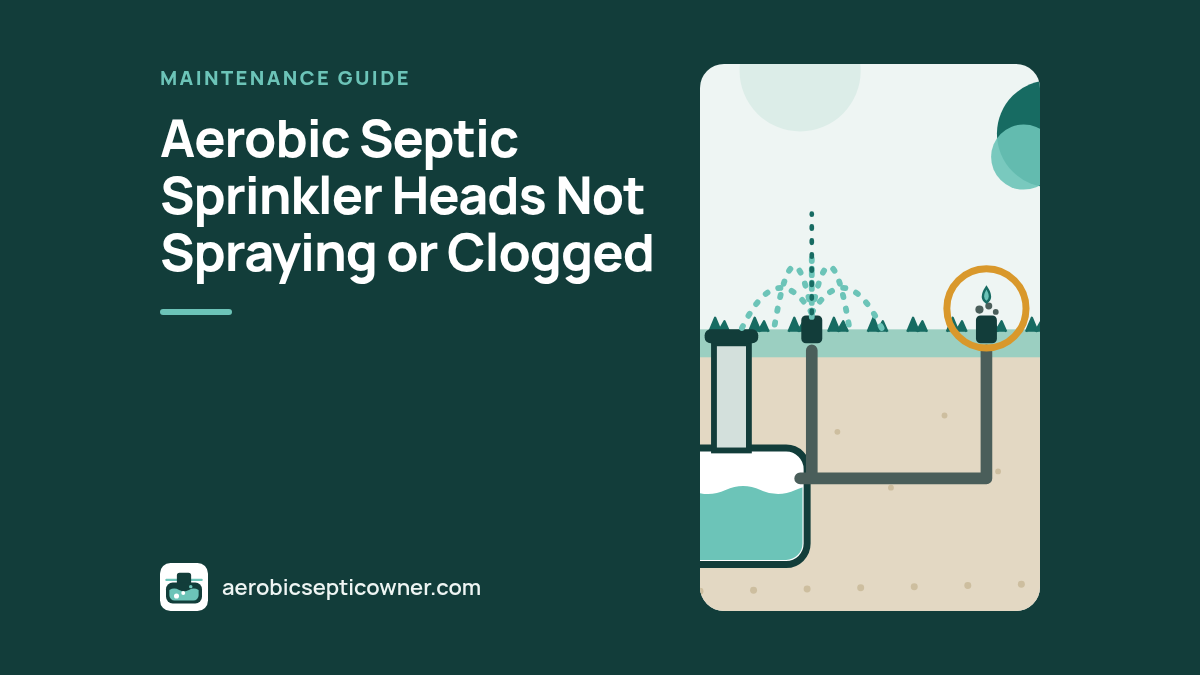
Texas A&M AgriLife Extension puts it in one sentence in its guide for owners of an aerobic treatment unit and spray field: although a spray field is like a lawn sprinkler, it should be viewed very differently.
That is the whole article in a line. The heads in your yard look like irrigation, and they are not. They disperse treated wastewater, they run on a dosing cycle rather than on demand, and in most jurisdictions they are part of a permitted system with rules attached. So when they stop spraying, the first question is not how to fix them. It is whether anything is actually wrong.
What are your sprinklers doing?
| What you see | What it points to | What to do next |
|---|---|---|
| Nothing spraying during the day, no alarm | Probably normal. Many systems dose in the early hours | Find out when yours is meant to dose before you call anyone |
| One head not spraying, weak or bubbling | That head: its nozzle, filter or riser | Note which head and ask your provider who may service it |
| All heads silent when they should be spraying | Upstream: power, pump, float, control panel or a line break | Note what the panel shows and call your provider |
| All heads weak | Pressure: a partly blocked line, a failing pump or a restricted filter | Note how far each head reaches and call your provider |
| High-water alarm and no spraying | The effluent pump is not moving water | Cut water use and call your provider |
| Wet or spongy ground along the line | A possible line break or surfacing effluent | Keep people and pets off, do not dig, and call your provider |
| Spraying during rain, or far more often after it | Rainwater may be getting into the system | Tell your provider when it happens |
Before anything: this is effluent, not irrigation water
Treat the spray area as treated wastewater, because that is what it is. Do not let children or pets play in the spray. Do not drink from it, wash with it, or point a head at a vegetable bed. If you handle a head, wear gloves and wash afterwards.
Texas A&M AgriLife Extension’s guide for owners is blunt about the legal side too: by law, water that leaves your property, either as runoff or by seeping into the ground, must meet certain quality standards demonstrated by laboratory tests. A spray head aimed at your neighbour’s fence is not a nuisance complaint waiting to happen; it is potentially a compliance problem.
Questions about children, pets or gardens near the heads? See our spray field safety guide.
First, is it supposed to be spraying right now?
This is where most owners go wrong, and it costs them a service call.
A spray field does not run continuously. Effluent collects in a pump tank, and the system doses it to the field when the level or the timer says so. Many systems are set to dose in the early hours, precisely so that nobody is outside when it happens. If you look at your yard at four in the afternoon and nothing is spraying, that is probably the system working exactly as designed.
Before concluding anything, establish three facts:
- Does your system dose on a timer, on tank level, or both? Your manual or your approved design will say. Your service provider certainly knows.
- When did you last actually see it spray? If the answer is “I have never seen it”, you may simply be asleep when it runs.
- Is the control panel showing an alarm? If so, start with our alarm checklist, because the alarm names the problem better than the heads do.
When it genuinely is not spraying
If you know the system should have dosed and it has not, the causes fall into a short list, and they are not equally serious.
No power to the pump. A tripped breaker or a failed GFCI. Check it, note whether it trips again, and stop resetting it if it does. A breaker that trips repeatedly is telling you something.
A high-water alarm with no spraying. This combination usually means the effluent pump is not moving water, either because the pump has failed, a float switch is stuck, or the control board is faulty. This is provider territory.
Clogged nozzles or filters. Irrigation guidance from Texas A&M’s water programme describes the common head faults plainly: missing or non-operating nozzles, which call for replacing the nozzle and its filter; poor distribution patterns, where the nozzle is damaged or blocked; and heads that bubble or gush instead of spraying, which usually means a cracked or broken nozzle. These are the mechanical faults most likely to affect one head while the others behave.
A broken or buried riser. Mowers, vehicles and frost all break risers. A head that was snapped off at ground level may be quietly flooding one patch instead of spraying.
Freezing. In cold weather, lines and heads can freeze. This is a seasonal pattern worth recognising rather than diagnosing as a failure.
A line break between pump and field. The pump runs, the tank level drops, and nothing reaches the heads. The clue is usually a wet or spongy area over the line, which is also a reason to walk the whole route rather than just look at the heads.
If a head is clogged: arranging safe service
Who may do the work. Ask your provider and your local permitting authority whether cleaning a head is an owner task on your installation or work for a licensed or trained person. Check your maintenance contract too. In Texas, for example, TCEQ says the contract must list the items it covers (TCEQ). Do not switch off the compressor as a cleaning step, change dosing settings, remove wastewater filters or reach into tank openings.
The right part. Ask the provider to identify the head, nozzle or strainer from your equipment record, say whether it needs cleaning or replacing, and give you the exact compatible part and a written estimate. An irrigation part that fits the thread can still have the wrong flow, pressure, throw or spray pattern. Do not move or turn a head to avoid a wet patch without design advice: where the effluent lands is part of the permitted design.
If it keeps clogging. A head that blocks again and again needs more than another rinse. Ask whether the provider checked for solids carryover, filters, treatment performance, piping and the pump, and ask for the findings behind any pumping or repair they recommend. How a nozzle looks does not show the condition of the tank. If the proposed work is large, use our repair or replacement worksheet.
One head versus all of them
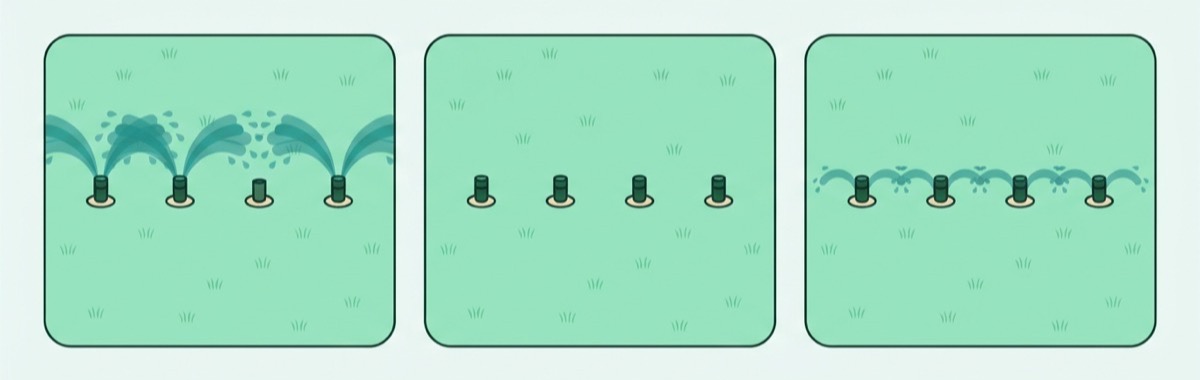
This single distinction will make your call to the provider twice as useful.
One head misbehaving — not spraying, spraying a thin stream, bubbling, or throwing a short distorted pattern — points at that head: nozzle, filter, or riser.
All heads silent — points upstream: power, pump, float, control panel, or a line break. Nothing is wrong with the heads at all.
All heads weak — points at pressure: a partially blocked line, a failing pump, or a filter restricting flow before the field.
Walk the field once and write down which heads did what. That note is worth more than any guess about causes.
Spraying when it should not be
The opposite problem is just as informative, and owners rarely report it.
Texas A&M AgriLife Extension advises evaluating system performance during rainy periods, because rainwater may be infiltrating the system if there is an unexplained number of dosing cycles, or if the spray distribution system is spraying during a rain shower. A system that doses far more often after heavy rain is telling you that water is getting in where it should not — through a damaged lid, a cracked riser, an unsealed inspection pipe, or a broken line. Our guide to septic tank risers explains what to report when water pools around a riser lid.
That matters beyond the nuisance. Extra water means less treatment time, a hydraulically overloaded field, and a higher chance of effluent surfacing. If your heads run during or just after rain, say so when you call. It is a diagnosis, not a complaint. Our guide on how much water an aerobic system can handle explains why loading matters so much.
When every head is silent, check the line before the heads
If none of the spray heads is working, the heads are almost never the cause. Check upstream first: the power to the pump, the pump itself, and the float switch that tells it when to run. The heads only show what the system has already failed to deliver.
Signs that the fault is between the pump and the field
- The pump runs, but the level in the pump tank drops and nothing reaches the heads.
- A wet or spongy patch appears along the buried line, away from any head.
- One zone works and another does not, which can point to a split or blocked branch.
- The pump sounds strained, or the heads spray weakly across the whole field.
What to note before you call
Record which heads work and which do not, whether the pump is audible during a dose, what the control panel shows, and where any wet ground is. The one-head-versus-all check above tells you where to start. Bring those notes to the visit so the provider can start from the line, not from the heads.
What to leave to the provider
Opening the pump chamber, testing the float switch, checking pressure and repairing a buried line are provider work on a permitted system. Digging near a buried line can also damage it. Do not dig to find a leak yourself.
General information only. Your system manual, your permit, your permitting authority and a qualified provider decide what is correct for your system.
What you may do, and what you may not
Reasonable for an owner: observing and recording which heads work, keeping grass trimmed around heads so the pattern is not blocked, keeping vehicles and heavy equipment off the field, and reporting what you see.
Not an owner job, in most cases: replacing heads or nozzles on a permitted system, opening the pump tank, electrical work, and anything that changes how much effluent lands where. A spray field is sized and positioned by an approved design. Moving a head a metre to avoid wetting the patio can put effluent outside the permitted area.
If wastewater is backing up or surfacing, keep people and pets away, cut nonessential water use and call your maintenance provider promptly. Do not run extra water to test a failing system, force a test cycle or open a pump chamber.
There is also the contract question. If your system is inside a mandatory maintenance agreement, doing the work yourself may breach it, and in several states work on a permitted system is reserved for licensed personnel. Our guide to what to check in a Texas maintenance contract explains how those agreements define covered and excluded work, including whether head replacement is included or billed separately.
If you are in Texas and want to maintain your own system after the initial contract period, Texas A&M AgriLife Extension and TCEQ both point to homeowner training courses for aerobic systems with surface application. That is the legitimate route, and it exists precisely because this work is not obvious.
What to tell your provider
Five facts turn a vague call into a prepared visit.
- Which heads are affected, and what each one does: nothing, trickle, bubble, or distorted pattern.
- Whether the control panel shows an alarm, and which light.
- Whether you can hear the pump run during a dose.
- Whether there is wet or spongy ground anywhere over the field or along the line.
- What changed recently: heavy rain, a freeze, mowing, a vehicle on the field, a power cut, or a lot of guests.
Questions to ask at the visit:
- Is the problem confirmed at the head, or still being investigated?
- Which part or service procedure is approved for this installation?
- Does the contract cover the visit, cleaning, parts and follow-up?
- Is there evidence of a wider treatment, pumping or line problem?
- What was checked after the repair, and when should we call again?
Our free printable service call log has space for exactly this, and handing it over at the visit is the single easiest way to get a straight answer.
Prevention
- Learn your dosing schedule once, and write it down. It ends half the false alarms.
- Keep grass trimmed around each head so the pattern is not deflected into one wet patch.
- Mark head positions so mowers and vehicles avoid them.
- Walk the field after heavy rain and after any freeze.
- After any service, write down the head affected, the diagnosis, the work and parts, the price, what was checked afterwards, and any remaining recommendation. Keep it with your free maintenance record so a repeat problem is easy to spot. Our maintenance calendar covers what belongs in the routine.
For Oklahoma’s installer and maintenance obligations, see aerobic septic rules in Oklahoma.
Free: six short email lessons for aerobic septic owners
Lesson 6 helps you put your next service visit, any permit deadline and the owner tasks your manual allows on a calendar. One lesson every two days, no cost.
No provider referrals. Unsubscribe in one click.
Sources
- Texas A&M AgriLife Extension, B-6234, “Living with an Aerobic Treatment Unit and Spray Field”, for how a spray field operates and the hazards of working around one, including disease-causing microorganisms and electrical shock.
- U.S. Environmental Protection Agency, How to Care for Your Septic System, for the instruction not to park or drive on the dispersal area, which is the most common cause of damaged heads and crushed lines.
- U.S. Environmental Protection Agency, Types of Septic Systems, for how treated effluent is dispersed and why the pump and dispersal stage depends on the treatment stage working.
- Oklahoma Administrative Code, OAC 252:641-10-3, for the rule’s own observation that sprinkler heads which retract properly but are damaged by careless actions fall outside the installer’s responsibility.
- Texas Commission on Environmental Quality, Maintenance of On-Site Sewage Facilities, for what a Texas maintenance contract must list. Checked October 15, 2026.
Limits of this guide
Educational information only, and not a diagnosis of your system. Spray fields are designed and permitted individually, and what you are allowed to do yourself varies by state, county and contract. Your system manual, your permit, your permitting authority and a qualified provider determine what is correct for your property. Treated effluent is not irrigation water: avoid contact, and keep children and pets out of the spray area. Effluent surfacing or leaving your property is a matter for your provider and your permitting authority.
Primary sources used: Texas A&M AgriLife Extension publication B-6234, “Living with an Aerobic Treatment Unit and Spray Field,” by Bruce J. Lesikar, Diane Bowen, Justin Mechell and Ryan Gerlich; irrigation maintenance guidance from the Texas A&M Water University programme; Texas Commission on Environmental Quality guidance on on-site sewage facilities.
Found something here that does not match your manual or your state’s rules? Tell us through our contact page and we will correct it.
Last reviewed: October 2, 2026.